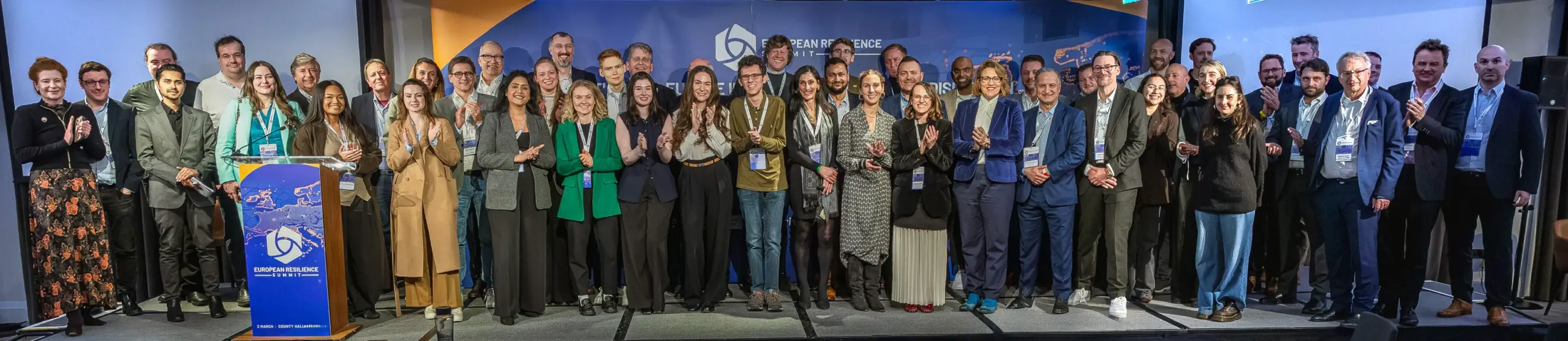
Across this edition of DSR Magazine Europe, one underlying pattern becomes clear: resilience in Europe is no longer a theoretical construct; it is an operational imperative. The reflections from London and the forward-looking perspectives towards Vienna converge on a single insight: resilience must be designed, coordinated, and continuously governed across borders, sectors, and systems. The European Resilience Summit (ERS) exists precisely at that intersection.
What distinguishes the summit is not merely its thematic focus, but its structural intent. In a landscape saturated with conferences, panels, and policy debates, ERS is positioned as a working environment rather than a talking stage. Its design, ranging from high-friction formats like the Doc-Read sessions to curated mainstage alignments between regulators, operators, and technology leaders, reflects a deliberate shift: from exchanging viewpoints to aligning decisions.
Interdependent layers
This is essential, because the complexity of today’s challenges does not lie in the lack of ideas, but in the fragmentation of execution. Digital sovereignty, supply chain responsibility, cyber resilience, and governance are not isolated domains. They are interdependent layers of a single system. Yet across Europe, these layers are still too often addressed in silos, by separate institutions, through disconnected policies, and with limited feedback loops between strategy and operations.
ERS addresses this gap by bringing together those who define the rules, those who build the infrastructure, and those who ultimately carry the responsibility when systems fail. The result is not consensus for its own sake, but something more valuable: clarity under pressure.
Collective capability
As highlighted throughout this magazine, the lessons from London already point in this direction. Whether it is the need for shared sovereignty models, the importance of operationalizing resilience in critical infrastructures, or the growing role of public-private collaboration, the common denominator is clear: resilience is a collective capability that cannot be owned by a single actor. Vienna will take this one step further.
Where London exposed the tensions between geopolitical ambition and operational reality, Vienna is set to deepen the conversation around execution: how to translate frameworks into action, how to measure resilience beyond compliance, and how to build systems that are not only secure, but adaptable under stress. And beyond Vienna, the trajectory continues.
Growing platform
The European Resilience Summit is not a series of isolated events, but a growing platform; one that connects cities, sectors, and strategic agendas into a continuous process. Each edition builds on the previous one, not by repeating conclusions, but by refining them, stress-testing them, and translating them into actionable direction.
For organizations operating in Europe’s digital and critical infrastructure landscape, the question is therefore no longer if resilience should be addressed, but how and with whom. ERS offers a place to answer that question; collectively, pragmatically, and with the level of urgency the current geopolitical and technological context demands.
The invitation is straightforward: not to attend another event, but to contribute to a process. Because resilience, ultimately, is not declared. It is built.