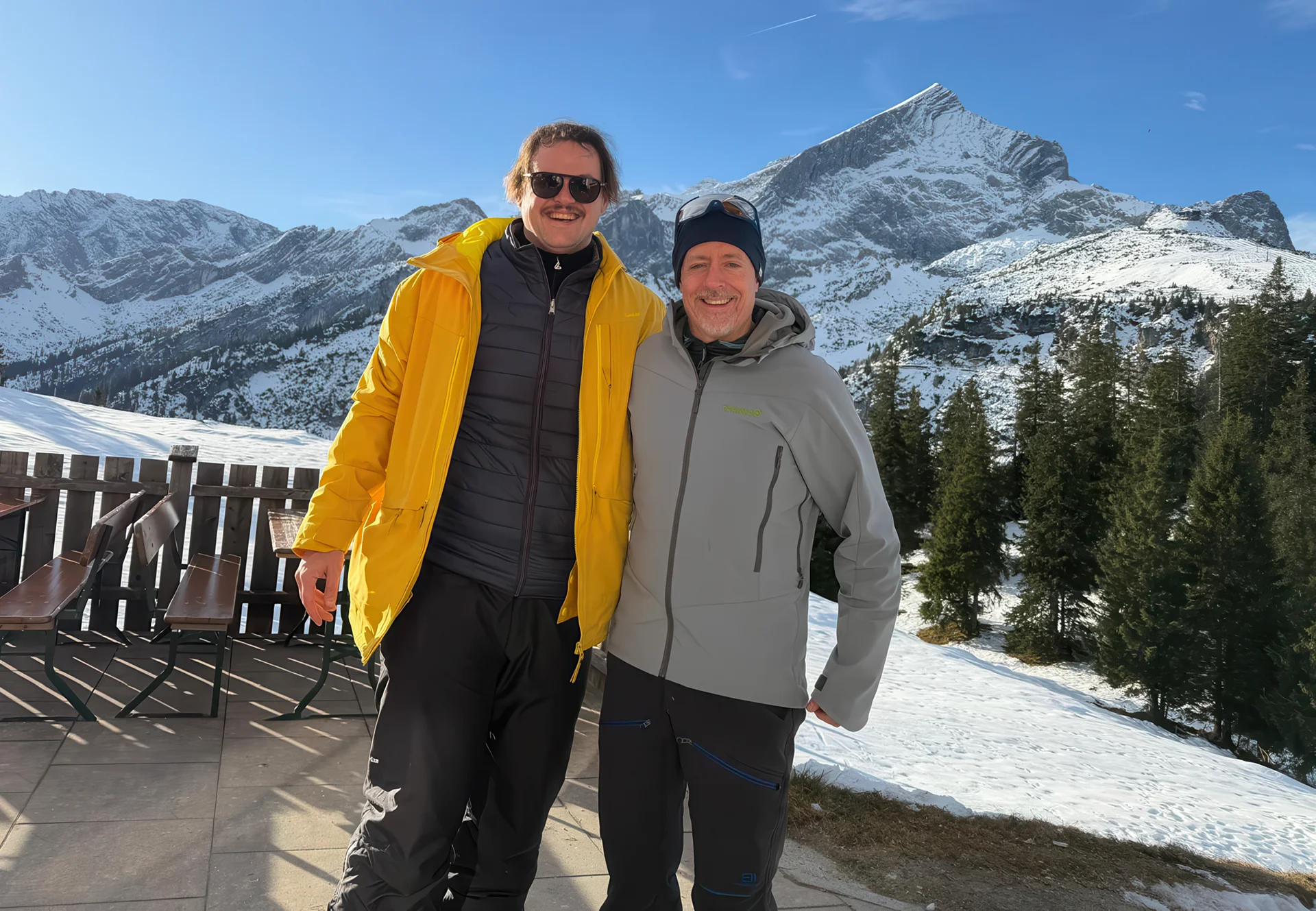
The idea for the European Resilience Summit did not originate in a strategy workshop, a boardroom, or a policy roundtable. It began, unexpectedly, on a run in the mountains.
TEXT: SANDER HULSMAN IMAGES: European resilience summit
In the Werdenfelser Land, around the Zugspitze on the German-Austrian border, the terrain is steep, fragmented, and constantly shifting in character. Valleys have their own rhythms, dialects change from village to village, and the Bergwacht operates with precise clarity about responsibility and jurisdiction. Yet something else becomes apparent when you move through that landscape: the formal national border matters far less than the shared reality of the terrain itself.
“It is a place full of boundaries, but not in the way modern politics often imagines them,” recalls Paul Hammer, Chief Executive Officer at Dockland Media Group. “What matters most is whether people know the terrain, trust one another, and are able to act when something goes wrong.”
Still function under pressure
For Philipp Müller, Vice-President Public Sector at DriveLock SE and TUM Think Tank Fellow of Practice at the Technical University of Munich, the same landscape triggered a different but complementary reflection. “In difficult environments, capability is always more important than abstraction,” he says. “You quickly realise that resilience is not theoretical. It is operational. It is about whether systems and people can still function under pressure.”
The deeper question was always the same: how do you remain capable of acting in a world where digital infrastructure has become geopolitical?
At the time, Hammer was preparing to launch Dockland Media and was thinking intensely about how to redesign the conference model itself. “I was asking a simple question,” he explains. “If we could build a conference series from scratch, what kind of series would we actually want to create? One that is less staged, less transactional, and genuinely useful for the people in the room.”
Digital sovereignty and operational independence
Müller had arrived at a parallel point of tension from a very different angle. Having recently moved from AWS to DriveLock, he was immersed in questions of digital sovereignty and operational independence in Europe. “We were building something very concrete,” he says. “R&D in Germany, operations in Germany, service in Germany, German board members, German investors. But the deeper question was always the same: how do you remain capable of acting in a world where digital infrastructure has become geopolitical?”
He adds that his earlier work with Israeli companies had left a lasting impression. “What struck me most was not their technology, but their instinct for mutual support under pressure. Not declarations of community, but real community. Real habits of cooperation when it matters.”
Beginning of a community
Somewhere in that combination of perspectives, while moving through the Höllentalklamm, the idea took shape. “Let us build a European Resilience Summit,” Müller says. “A place where Europe can seriously work on how to remain capable in times of disruption.”
Hammer immediately sharpened the concept. “Fine,” he responded, “but then it cannot be a one-off event. It has to be a series. And not just a series of summits, but the beginning of a community.”
That distinction would become foundational. The Summit was never intended as an isolated conference. It was conceived as infrastructure: for relationships, for learning, and for sustained cooperation across Europe.
From the outset, Europe was the only meaningful frame. “Europe is strong, but fragmented,” says Hammer. “We still tend to operate in national, sectoral, and institutional silos, while the systems we depend on are increasingly cross-border and cross-sector.”
We wanted a genuinely European platform where leaders from government, industry, technology, security, academia, and civil society could engage with problems they all actually share
Not vision, but mechanisms
Müller expands on the same diagnosis: “Much of Europe’s intelligence, capability, and goodwill already exists. The problem is not absence, it is dispersion. We have strength, but not connection. Not vision, but mechanisms.”
This mismatch, they argue, is now one of the defining conditions of the continent. Cybersecurity, energy systems, AI infrastructure, industrial capacity, supply chains, and regulatory frameworks no longer align neatly with national structures. Yet Europe continues to govern and discuss them as if they do.
“That is why we deliberately rejected the idea of a national conference with occasional international guests,” Hammer says. “We wanted a genuinely European platform where leaders from government, industry, technology, security, academia, and civil society could engage with problems they all actually share.”
Strategic vocabulary in European debates
If Europe was the frame, resilience was the deliberate conceptual choice. At the time, sovereignty dominated much of the strategic vocabulary in European debates. Both founders understood its appeal. “Sovereignty points to something real,” Müller says. “The desire not to be structurally dependent, not to wake up and discover that your essential systems are controlled elsewhere.”
But over time, they began to see its limitations as an operational concept. “Resilience forces a different question,” Müller continues. “What must still work when conditions turn against you? Which capabilities do you actually need in order to act under pressure?”
Ability to thrive in disruption
Hammer adds a complementary perspective: “Sovereignty is often a political aspiration. Resilience is a discipline. It requires governance, industrial depth, technical competence, and habits of cooperation. It does not allow you to stop at rhetoric.”
For both, resilience also carries a forward-looking dimension that sovereignty often lacks. “It is not just about protection,” Hammer says. “It is about the ability to thrive in disruption.”
That word, thrive, is central. It reframes resilience not as defensive posture, but as adaptive capacity under uncertainty. The urgency of the work, they argue, is what gives the project its structure. “We are no longer in a period where disruption is exceptional,” says Hammer. “It has become the operating condition.”
Müller is even more direct: “Geopolitical rivalry is now a question of infrastructure. AI, cloud systems, and critical supply chains are strategic assets. That means capability has to be built now, not in some future planning horizon.”
When systems fail, people call people. They rely on relationships built long before the crisis
Four operational dimensions
This urgency shaped the design of the Summit from the beginning. The ambition was not to produce another high-level talking shop, but something closer to an action platform. “We did not want a stage where impressive people repeat familiar lines,” Hammer says. “Too many conferences confuse visibility with usefulness.”
Instead, the focus shifted toward structured interaction between strategy and execution. Participants were expected not only to discuss resilience, but to work on it. Out of that intention, four operational dimensions gradually emerged as the backbone of the programme.
- The first is hardening organisations: governance, decision-making, operational readiness, cyber resilience, and the ability to function under stress.
- The second is building resilient industries: strengthening Europe’s capacity in cybersecurity, cloud, defence, and critical infrastructure, while aligning incentives between policymakers, operators, investors, and builders.
- The third is learning how to work with global technologies without becoming structurally dependent: designing procurement models, governance frameworks, and safeguards that increase capability rather than vulnerability.
- The fourth is building communities of practice: the often underestimated foundation of resilience, where trust, familiarity, and informal coordination determine what happens when systems are under pressure.
“Ultimately, resilience is social,” Müller says. “When systems fail, people call people. They rely on relationships built long before the crisis.”
Everyone starts from the same informational baseline. The conversation becomes less about performance and more about substance
Doc-Read
To support that ambition, the Summit also developed one of its most distinctive formats: the Doc-Read. Inspired by Amazon’s narrative memo culture, it is based on a simple principle: disciplined writing produces disciplined thinking. “Instead of starting with presentations, participants read a short document in silence,” Hammer explains. “Only then does the discussion begin.”
The effect is subtle but significant. “It reduces hierarchy in the room,” Müller notes. “Everyone starts from the same informational baseline. The conversation becomes less about performance and more about substance.”
Over time, the Doc-Read has become a defining expression of the Summit’s philosophy: structure before speech, argument before reaction. Since its inception, the series has moved through Berlin, Paris, Davos, London, and continues onward to Vienna. For the founders, the repetition is not incidental. It is essential.
“A single summit can create energy,” Hammer says. “A series creates memory, trust, and cumulative learning.” Müller agrees: “Trust does not come from declarations. It comes from repeated interaction, shared work, and disagreement handled well.”
The real topics
What they have observed across these gatherings is a growing appetite for seriousness. “There is a strong demand for environments where people can move beyond slogans and talk about implementation,” Müller says. “Procurement, architecture, governance, trade-offs; these are the real topics.”
Hammer frames the same insight differently: “Europe does not need more abstraction. It needs better interfaces between strategy and execution.” Perhaps the most important insight, however, is the least visible. “Community is not a byproduct of the Summit,” Hammer says. “It is the Summit.”
Cultivate a European community
The visible events, the stages, the cities, the sessions, are only surface manifestations. The deeper ambition is to cultivate a European community of practice capable of thinking together, arguing constructively, and acting in coordination when conditions deteriorate.
Müller puts it in more structural terms: “Europe will not become more resilient by withdrawing from interdependence. It will become more resilient by learning to shape interdependence intelligently.”
European learning system
As they look ahead, both founders describe a trajectory that is less about expansion than maturation: a more coherent, cumulative system of learning across Europe, distributed across cities but unified in intent. “We want it to become a European learning system,” Hammer says. “Not a single event series, but a rhythm.”
And that rhythm, they suggest, ultimately returns to where the idea first emerged: the mountains. “In that terrain,” Müller reflects, “you understand very quickly that survival depends less on borders than on competence, trust, and cooperation.”
Hammer concludes: “The Summit began as a conversation between two people on a run. It became a series. And if we are right, it is becoming something more durable: a community that helps Europe remain capable in a disrupted world.”