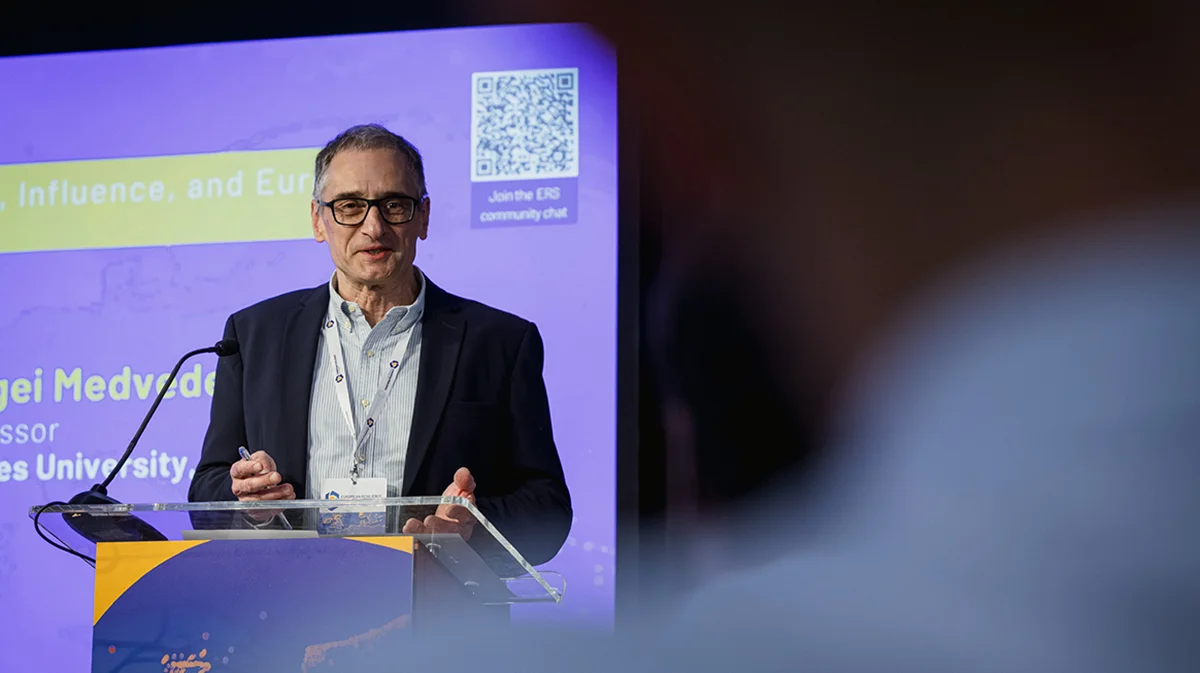
At the European Resilience Summit London, geopolitical analyst Sergei Medvedev delivered a keynote that reframed one of the central debates in today’s geopolitical landscape: what sovereignty actually means in an interconnected world.
TEXT: SANDER HULSMAN IMAGE: EUROPEAN RESILIENCE SUMMIT / ENVATO
As Medvedev noted early in his address, “we are living in interesting times”, a reference to the well-known phrase often attributed to Chinese political wisdom. The international system is under pressure from multiple directions: ongoing wars, geopolitical rivalry and rising nationalism. Yet the deeper disruption, he argued, lies in how political leaders increasingly interpret sovereignty itself.
The illusion of territorial sovereignty
Medvedev pointed to the resurgence of a worldview in which geopolitical power is framed in purely territorial terms. Referring to political rhetoric around territorial expansion and strategic land acquisitions, he described this mindset as a “real estate logic of sovereignty.”
“For him, sovereignty is a spot, a piece of land which can be successfully developed, like building a skyscraper,” Medvedev said. “Land can be grabbed, occupied or exchanged. It’s transactional.” In this vision, international politics resembles a negotiation table where territories can be traded much like properties in a business deal. Medvedev compared this logic to 19th-century imperial practices, when colonial powers literally drew borders across maps.
Sovereignty is no more than a myth. It has always been constrained, conditioned and violated whenever it was convenient
But the world, he stressed, no longer works that way. Political scientist Stephen Krasner famously described sovereignty as “organized hypocrisy.” The concept suggests that absolute sovereignty, complete control within national borders, has never truly existed. As Medvedev explained: “Sovereignty is no more than a myth. It has always been constrained, conditioned and violated whenever it was convenient.”
Greenland as a geopolitical paradox
Few places illustrate this better than Greenland. The Arctic island has become a symbol of geopolitical competition, yet its governance structure reveals a far more complex reality. Greenland is formally part of the Kingdom of Denmark but enjoys extensive political autonomy. It hosts strategic infrastructure connected to the United States and operates within the security architecture of NATO.
At the same time, it maintains its own political identity and independence movement. According to Medvedev, the island effectively embodies multiple overlapping sovereignties. “Look at this island,” he said. “You see overlapping EU, NATO, American, Danish and Greenlandic sovereignties; five sovereignties on the same island.”
Despite this complexity, the arrangement has functioned for decades. Rather than weakening governance, this network of dependencies has allowed Greenland to remain stable while serving as a critical node in transatlantic security and Arctic cooperation.
Sovereignty as a network
For Medvedev, Greenland highlights a broader transformation in how sovereignty operates in the modern world. “Sovereignty is a multi-layered story,” he explained. “It is a web of rights, conditions and dependencies.”
This perspective aligns closely with the European governance model developed within the European Union. Over decades, Europe has built institutions that pool authority across states rather than centralizing it within one. Medvedev described this as a fundamentally different philosophy from territorial nationalism. “Europe has built an extraordinary experiment of shared and networked sovereignty.”
In this model, power comes not from owning territory but from participating in systems like trade networks, legal frameworks, security alliances and technological infrastructure. This logic increasingly defines global power dynamics, particularly in digital and technological domains where interoperability matters more than ownership.
Lessons from Greenland’s past
The history of Greenland itself reinforces this point. Medvedev recalled how Norse settlers led by Erik the Red established farming communities on the island in the 10th century. These settlements eventually disappeared. Their collapse, he explained, was not merely the result of climate change or isolation. It stemmed from an inability to adapt.
The settlers tried to reproduce Scandinavian agriculture in an Arctic environment, raising cattle and sheep despite increasingly harsh conditions. Meanwhile, Inuit communities adapted their lifestyles to the realities of the Arctic. “Sovereignty is about adaptation,” Medvedev said. “It is not about owning a piece of ice.”
The Inuit survived precisely because their culture was built around flexibility in hunting, migration and environmental knowledge. For Medvedev, this historical lesson remains relevant today. “Real sovereignty is about surviving, adapting and building a network of shared dependencies.”
Greenland matters not because it is a vast piece of Arctic land, but because it reveals something fundamental about the international order
Europe’s strategic opportunity
This insight carries important implications for Europe. While debates often focus on Europe’s military or geopolitical limitations, Medvedev argued that the continent has already pioneered a powerful alternative model of sovereignty. “Europe should reflect on its success of the past eighty years, building a unique experiment of pooled sovereignty.”
The European model demonstrates that sovereignty can function as a capacity, not merely a boundary. By sharing authority across institutions and alliances, states can enhance their collective resilience.
In an era defined by interconnected systems, from digital infrastructure to climate governance, such networked sovereignty may prove more effective than attempts to restore absolute national control. Greenland, sitting at the intersection of security, climate and geopolitics, illustrates exactly how this new logic works.
From ownership to adaptation
Medvedev closed his keynote with a broader reflection on the future of sovereignty. Territorial expansion, he argued, belongs to an earlier geopolitical era. In today’s interconnected world, power is shaped by systems rather than borders. Greenland therefore matters not because it is a vast piece of Arctic land, but because it reveals something fundamental about the international order. As Medvedev concluded: “In the modern world, it is more important to share and use things than to own them.”